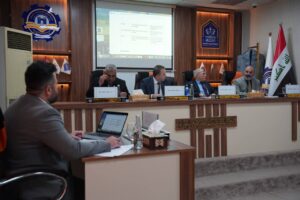
The Technical Engineering College / Mosul examined the technical master’s thesis in the specialization of Construction Materials Engineering Technologies, entitled:
“Synergistic and Complementary Effects on High-Performance Polymer Repair Concrete Containing Supplementary Cementitious Materials and Admixtures.”
The thesis submitted by the researcher Mohammed Hatim Majid Hamed addressed the challenges associated with the repair of concrete structures in sulfate-rich environments, particularly in Iraq. These challenges are primarily manifested in the failure of conventional repair materials based on ordinary Portland cement, due to poor bonding between old and new concrete, increased shrinkage, and reduced chemical resistance. Such deficiencies often result in debonding, peeling of repair layers, and premature failure.
The study aimed to develop High-Performance Polymer Repair Concrete (HPPRC) by utilizing sulfate-resistant cement (SRC) in combination with supplementary cementitious materials, namely silica fume (SF) and ground granulated blast furnace slag (GGBFS), in addition to epoxy resin and polypropylene fibers. This approach sought to enhance mechanical properties, reduce permeability, and improve bond strength between the existing concrete substrate and the repair concrete, particularly under aggressive environmental conditions.
The research also included an experimental program involving the design and preparation of eighteen (18) different concrete mixtures. The effects of varying additive proportions were investigated in terms of compressive strength, flexural strength, bond strength using the slant shear method, and water absorption at curing ages of 28 and 90 days, in order to simulate real service conditions.
The results demonstrated that the integrative combination of sulfate-resistant cement, supplementary cementitious materials, and polymer significantly enhanced the performance of repair concrete. Notably, high bond strength values exceeding international standard specifications were achieved, along with a marked reduction in water absorption, indicating increased density and durability when compared to conventional repair concrete.
The thesis recommended adopting a ternary concrete repair system incorporating 15% silica fume, 20% blast furnace slag, and 5–10% epoxy resin for infrastructure repair projects exposed to sulfate attack, such as bridges, industrial floors, and marine structures. It also suggested expanding future research to include long-term durability testing and field studies to further validate the reliability of this type of concrete in practical applications.
The examination committee consisted of the following members:
-
Prof. Dr. Mohammed Maslah Salman – Chairperson
-
Assoc. Prof. Dr. Muthanna Adel Najm – Member
-
Lect. Dr. Mohammed Shakib Mohammed Yahya – Member
-
Assoc. Prof. Jassim Mohammed Abd – Member and Supervisor